

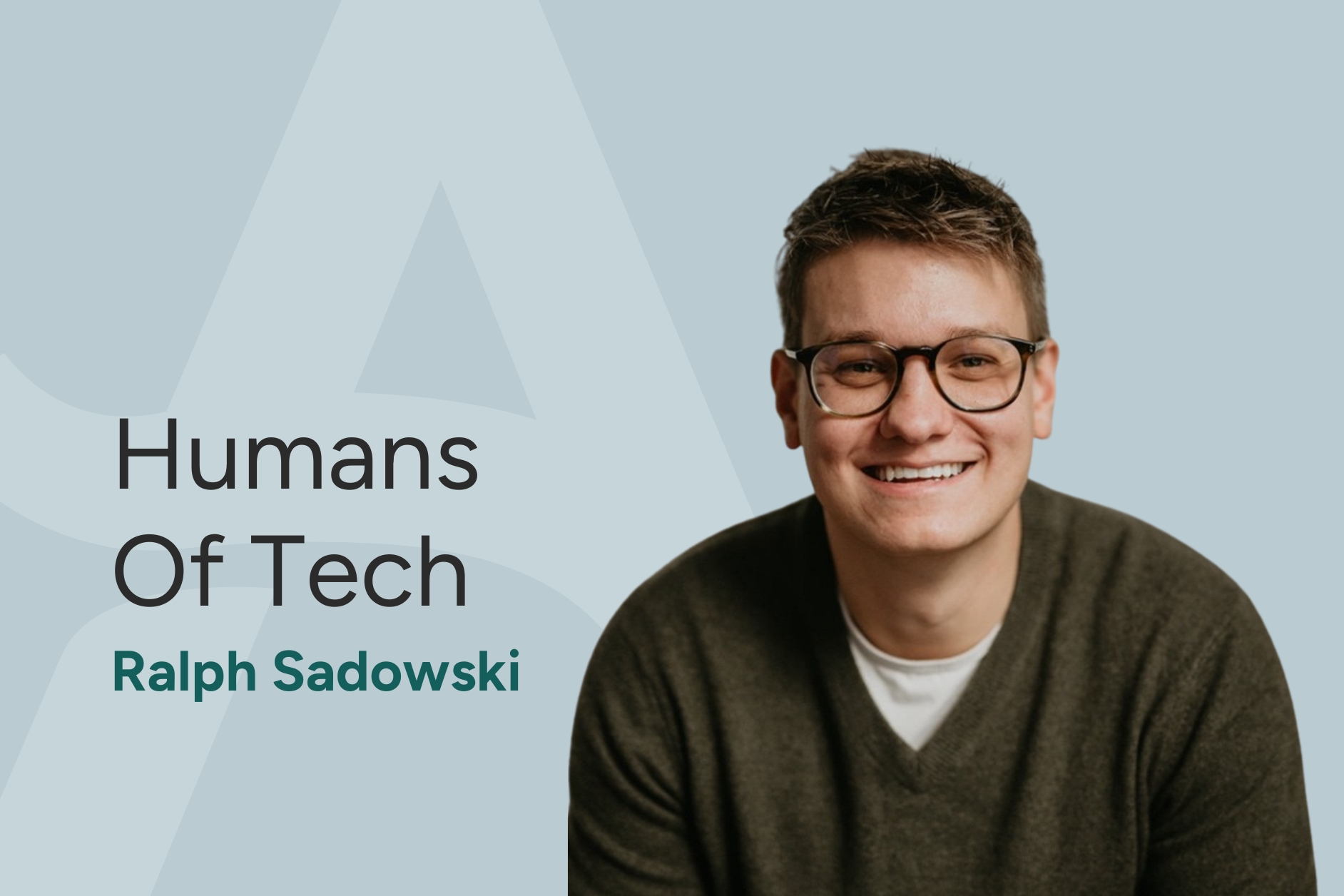
If you ask Ralph Sadowski what he does, he’ll tell you he’s a “builder-operator.” In practice, that’s meant roles like Chief of Staff, Director, and Head of Business Operations at companies including Uber, Neo Financial, and Shopify, stepping into high-leverage roles where something new needs to be built or scaled.
Based in Calgary, he’s helped grow Uber across Western Canada, joined Neo as employee #6 to help build a digital bank from scratch, and worked closely with senior leaders at Shopify on strategy, operations, and 0-to-1 initiatives. “I’m part of this lucky cohort in YYC who’ve gotten to build global companies from here,” he says.
The throughline is adaptability. “Founders trust that I’ll climb the mountain and look for the next one,” he says. It’s harder to explain at a dinner party. “Eventually I just say: I help build and grow the business. They nod, and we move on.”
Right now, Ralph is focused on the human side of building. While he’s known for analytical, objectives-driven work, he’s increasingly leaning into what people don’t expect: empathy. “You need strong analytics to do this well,” he says. “But the real leverage often comes from EQ.”
That focus shows up in MentalWealth, a writing project where he distills mental models in five minutes or less. It’s a way to sharpen his thinking, practice storytelling, and share what he’s learning. “I used to think of myself as just the numbers guy,” he says. “But I’m actually very relationship-driven, and that turns out to be a strength.”
Ralph began his career with a clear plan: finance. It felt like the most ambitious path in university, and he worked hard to get there. After graduating, he landed a role in capital markets, but it quickly became clear it wasn’t the right fit. He understood the markets, but not the sales-driven nature of the trading floor and he didn’t have the desire to build that passion over time.
At 24, it felt existential. “I’d worked so hard to get there, and suddenly I didn’t know what came next.”
As he prepared to leave finance, he stumbled across a job posting for Uber and remembered the first time he used the product in Toronto. He thought back to a finance class that introduced him to creative destruction, the idea that progress comes from building something better than what came before. “That’s when it clicked, this is what creative destruction looks like.”
Joining Uber became a turning point, one he’s grateful happened early. It taught him that moments that feel like failure are often where the most growth begins.
Looking back, the advice he’d give his younger self is simple: don’t worry about prestige, worry about experience. “Nothing you do in life is a mistake,” he says. Today, he optimizes for breadth. “In your twenties, you need to learn what hard work looks like, but you also need inputs: travel, hobbies, curiosity.” Those inputs, he believes, become the raw material for creativity later on. “You need inputs to get output.”
Ralph has worked in environments where “sink or swim” was the default. He sees its value, but also its limits. “It’s a toolkit,” he says. “But you do people a disservice if you don’t help them feel supported.”
For Ralph, learning comes first and curiosity is the unlock. When he’s hiring, baseline competence matters, but attributes matter more. “Curiosity is more valuable than progression,” he says. He looks for people who are genuinely interested in the problem itself, knowing that growth follows. “Curiosity helped me figure it out,” he says of joining Uber without prior tech experience.
That philosophy carries through to onboarding and culture. “Onboarding isn’t ‘good luck,’” he says. “It’s something we do together.” He experienced this at Uber Canada, where a small team scaled a massive business by solving problems in the trenches together. “If you had a problem, you weren’t on the ship by yourself.” Belonging came from shared ownership and pride in the work.
The same principle applies to systems. One of Ralph’s biggest lessons from Uber was the difference between effectiveness and efficiency. “People optimize too early,” he says. Uber focused on being effective first, learning through imperfect, local solutions, before optimizing at scale. “They’re different muscles,” he says. “You have to build them separately.”
To create environments where people feel both challenged and supported, Ralph thinks at two levels: company and individual.
At the company level, it starts with treating people like adults. “Operate with candour and respect, don’t use candour as an excuse to be an asshole,” he says. That means trust, transparency, and clarity. “If you don’t have clarity on the mission, you can’t do the rest.”
At the individual level, he sees leadership as thought partnership. “I might have more context, but I’m not here to sit above you,” he says. “I’m here to help you think through problems.” Support, to him, means solving together as thought partners, empowerment backed by systems, not absentee leadership. If he had to sum up his style in three words: genuine, human-first, curious.
As part of Humans of Tech, I always ask what piece of technology someone wishes existed. For Ralph, the answer is very practical. With two little ones at home, one a newborn, his dream product is a robot that does the laundry. “Laundry is the crux of why this house doesn’t work,” he jokes. “I’d remortgage my house for a robot that launders, dries, and folds the clothes.” (Same. Investors? Whose in?).
More broadly, the shift in tech that excites him most is the rise of the solopreneur. He points to Shopify’s work lowering the barrier to entrepreneurship, and how AI is accelerating that trend. “If you have willingness and curiosity, you’re enabled,” he says.
Would he build a company himself? Maybe, but not a unicorn. His ideal is “a great business that feeds my curiosity and creates freedom.” His core values: freedom, curiosity, and family, align naturally with that path.
When asked what he hopes his legacy will be, Ralph doesn’t talk about titles or companies. He talks about place.
He and his wife both grew up in Calgary, spent time elsewhere, and made a deliberate choice to build their life and careers at home. His ambition is to help push the city forward, to bring back experience, perspective, and confidence, and to help prove that world-class careers and companies can be built from YYC.
Not by leaving, but by staying and contributing.
“If you contribute to Calgary,” he says, “you contribute to Canada.”
Check out MentalWealth

Read more insights from our team.
.jpg)

Founded by Kristina McDougall in 2013, Artemis has grown to become Canada’s most trusted boutique executive search firm for startups.
We recognize that our work takes place on the traditional lands of the Attawandaron, Anishinaabeg, Haudenosaunee, and Mississaugas of the Credit. We honour Indigenous stewardship and commit to embedding reconciliation into our work, holding ourselves and our clients accountable.