

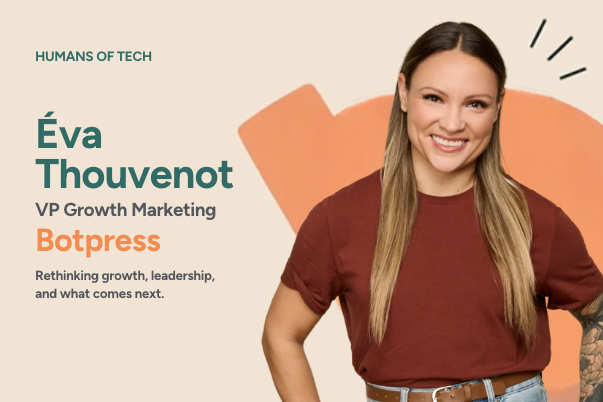
Meet Éva Thouvenot, VP of Growth & Marketing at Botpress. She's built a career figuring out how SaaS companies grow, but ask her what she does for a living, and she'll often reach for a more familiar example.
“Ever used Duolingo? Think about how you found it. Maybe you wanted to learn Spanish, did a quick Google search, downloaded the app, and eventually decided to pay for it.”
That entire journey, from the first spark of interest to becoming a customer, is the world Éva works in.
It's a much bigger world than most people realize. Marketing can mean entirely different things depending on the company, industry, and stage of growth. For Éva, the challenge isn't finding things to do. There's always more to do. It's knowing which opportunities are worth pursuing, where to focus her energy, and just as importantly, what to leave alone.
Éva's interest in technology goes back to childhood. She was always drawn to computers and even imagined becoming a developer one day. That is, until a university IT course convinced her otherwise. Looking back, she recognizes how little she understood about what software development actually involved.
Her path into tech ended up being far less conventional. She started in e-commerce, built and sold her own company, and found herself wondering what to do next. A job posting at Bench Accounting caught her attention, partly because the CEO seemed interesting. A little curiosity, some fortunate timing, and a series of unexpected decisions eventually led her into the world of SaaS. She's been hooked ever since.
If she could offer her younger self any advice, it would be to keep trusting her instincts. Throughout her career, she's heard plenty of opinions about what a successful career should look like and whether certain decisions would be "good for her career." But Éva has never been particularly fond of being told what to do.
She's welcomed other perspectives without feeling obligated to follow someone else's definition of success, choosing instead to pursue work she's passionate about and where she believes she can make an impact. Her career might look unconventional on paper, but she wouldn't change it. As she sees it, she's exactly where she's supposed to be.
Some career experiences teach you what works. Others force you to question everything you thought you knew. Éva has had her fair share of both.
At Bench Accounting, she discovered what truly intentional leadership could look like. She'd led teams before, but had never experienced a company so deeply invested in developing its people, and hasn't encountered anything quite like it since. Managing and coaching weren't responsibilities you squeezed in around your "real" job. They were the job.
The experience pushed her to think more deeply about the leader she wanted to become and to develop practical frameworks for hiring, coaching, and feedback that she still carries with her today.
After an incredible, if exhausting, chapter at Bench, Éva was ready for something different. She joined Bonsai wanting to work with a smaller team, roll up her sleeves, and get closer to the work again. But she quickly discovered that some of the growth strategies she'd relied on in the past weren't delivering the same results. The landscape had changed, and approaches she'd spent years refining needed rethinking.
Rather than holding on to what had worked before, Éva began experimenting with new approaches. That willingness to rethink the playbook ultimately uncovered an entirely different customer opportunity, opening up a significant new revenue stream and changing the company's trajectory.
It was a valuable lesson in the limits of experience. Sometimes experience gives you the confidence to know what works. Other times, it gives you the confidence to recognize when it doesn't anymore.
One of Éva's most important leadership principles is "curiosity over blame." Early in our careers, it's easy to point fingers when something doesn't work. As we move into leadership, that blame often turns inward. Neither, she believes, gets us very far.
Instead, she asks how things got to where they are, what could have been done differently, and what needs to happen next. Rather than dwelling on who or what was responsible for a problem, she's more interested in what can be learned from it. The distinction is simple, but it changes the conversation.
That curiosity goes hand in hand with another principle she takes seriously: "taking 100% responsibility." Éva draws a distinction between control and accountability. You can't control every outcome, but you can be fully accountable for your commitments, your actions, and the impact you have on others. It's an approach that requires empathy as much as ownership, and one that has fundamentally shaped how she leads.
Those same principles guide how she hires. Beyond technical expertise, she looks for "extreme curiosity," low ego, and high accountability. She's particularly interested in how candidates talk about failure. Can they acknowledge what went wrong without sugarcoating it? Can they explain what they learned and, more importantly, what they changed?
With AI transforming the way marketers work, she's also looking for people who are genuinely experimenting and pushing the boundaries of their own practice. She doesn't believe there's only one way to do that, but she cares about how deeply someone has explored the tools available to them. It's usually clear who has actually put in the work to try, learn, and adapt.
For Éva, being a great leader, or a great marketer, has less to do with always being right than with being willing to question yourself, take responsibility, and keep improving.
Éva knows the kind of environment where she does her best work, and she's found it at Botpress. She describes needing a "big sandbox," somewhere she has the autonomy to make decisions, build her team, and take full responsibility for the results.
She's comfortable being challenged and held to high standards, but wants the freedom to make her own calls and be measured on their impact. If something doesn't work, she'll own it. What matters is having the trust to make bold bets in the first place, without feeling that every decision has to be the right one.
Equally important is a culture where people can tell each other the truth. Éva cares deeply about the people she works with, but doesn't believe kindness means avoiding difficult conversations. She sees withholding feedback as depriving someone of the opportunity to grow.
She puts that belief into practice through regular coaching conversations, with both sides coming prepared to reflect on what went well, what didn't, and what they've learned. The goal isn't simply to review performance, but to identify the habits and behaviours that might lead to a different outcome next time.
And she makes a point of inviting that same feedback herself. She knows it can be intimidating to challenge a VP, especially at first. But by repeatedly showing that she can hear difficult feedback without becoming defensive, and that she's willing to act on it, she helps make those conversations feel more natural. It's a muscle that gets stronger with practice.
Ask Éva to describe her leadership style in three words, and she'll choose empowering, growth-oriented, and caring. She loves ambitious goals, momentum, and pushing people to discover what they're capable of. Her expectations are high, but so is her commitment to helping others meet them.
Nothing excites her more than seeing people thrive, and she's not particularly interested in the idea that only certain people on a team can be exceptional. Why shouldn't everyone have the opportunity to thrive?
If Éva could invent one piece of technology, it would be an avatar of herself. Not one to answer emails or take meetings, but something that could preserve past versions of who she was. She imagines being able to revisit old perspectives, have conversations with her former self, and see how she's evolved from the outside looking in. After all, the person she is tomorrow won't be quite the same as the person she is today.
It's a fitting answer for someone who sees the most interesting part of AI as something much bigger than the technology itself. Éva believes we're entering a period where nearly every role is being redefined, forcing us to reconsider not just how we work, but who we are.
There's excitement in that possibility, but anxiety, too. How do we let go of the professional identities we've spent years building? How do we decide who we want to become when the future is already arriving around us? For Éva, the challenge is embracing that uncertainty rather than holding too tightly to what's familiar. There's something both uncomfortable and extraordinary about having to reinvent ourselves.
And while she's fascinated by what technology makes possible, her greatest passion remains people. She's spent much of her career thinking about human behaviour, performance, and what it takes to help others thrive. For years, her ambition was to become the best leader she could possibly be and share what she learned, hoping those lessons might have a ripple effect through the people and teams she influenced.
Now, she's revisiting that ambition through the lens of AI. What does it mean to lead in a world where humans and AI agents increasingly work alongside one another? How will teams change, and what will it take to lead them with the same level of care, empathy, and accountability?
It's a new set of questions, and Éva doesn't pretend to have all the answers. But perhaps that's the point. In a career shaped by curiosity, unexpected turns, and a willingness to challenge what she thought she knew, the next chapter is another opportunity to keep learning, evolving, and helping others do the same.

Read more insights from our team.


Founded by Kristina McDougall in 2013, Artemis has grown to become Canada’s most trusted boutique executive search firm for startups.
We recognize that our work takes place on the traditional lands of the Attawandaron, Anishinaabeg, Haudenosaunee, and Mississaugas of the Credit. We honour Indigenous stewardship and commit to embedding reconciliation into our work, holding ourselves and our clients accountable.